
Die Kasseler Liste – The World’s Largest Catalogue of Banned Books
Die Kasseler Liste is a growing database that presently comprises approx. 160,000 data sets. It documents the global scale of censorship. Book bans persist across the world, on all continents, with varying reach and intensity, depending on political and social contexts. Anyone can contribute to make the past and present of censorship more visible.
Historical and Current Indices
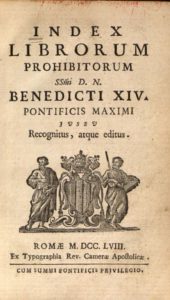
Index Librorum Prohibitorum
Die Kasseler Liste covers vast territories and a large time frame. The earliest entries are taken from the “Index Librorum Prohibitorum,” which the Catholic Church first published in 1559 and which is represented in the database in its final version from 1948. Many states and countries, civil and religious institutions have a similar history of systematically infringing on the right to freedom of expression.
Historical indices like the Index Librorum Prohibitorum are an important component of Die Kasseler Liste. Whenever possible, they are reproduced in their entirety, such as the “Liste des schädlichen und unerwünschten Schrifttums” of the Third Reich, the “Liste der auszusondernden Literature” in the Soviet Occupation Zone and later in the GDR (1946–1953), or the current index of the Catholic lay organization Opus Dei (i.e. the books listed therein with a ‘prohibition grade’ between 3 and 6). Additional recent bans included in Die Kasseler Liste originate from the United States. Censorship is currently widespread there, particularly in schools, school libraries, and public libraries. Book bans documented by PEN America and the ALA (American Library Association) are included in Die Kasseler Liste for selected years. Censorship in U.S. prisons is even more widespread than in school libraries. Activist groups such as Books to Prisoners or the Marshall Project document lists they receive from U.S. judicial authorities via FOIA requests. We have processed many of these lists for our database.
Research Databases
However, censorship doesn’t always result in lists of banned books, with good reason. On the one hand, states that engage in censorship often want to seem unpredictable in their actions, and an official list would run contrary to this goal. Censorship is often arbitrary and illogical, depending on the current political climate, and it thus creates a permanently threatening atmosphere. On the other hand, an index openly acknowledges the fact that the state is indeed engaged in censorship. Naturally, restrictive states that are officially free of censorship will avoid such an acknowledgement.
To document censorship in those contexts where indexes don’t exist, Die Kasseler Liste relies in part on other databases, built by fellow researchers. Some of them are freely accessible like “Zensur in Österreich 1750–1848” (https://zensur.univie.ac.at/). This vast database curated by the University of Vienna since 1999 contributed a large number of datasets to our list, thanks to the generosity of Norbert Bachleitner. Henrique Bordini (FAU Erlangen-Nürnberg) has given us permission to include the results of his archival research on censorship under the Brazilian dictatorship. The project “Banned in Australia” (AustLit), led by Nicole Moore, provides insight into 20th-century Australian censorship through Die Kasseler Liste.
Individual Research
But of course, many parts of the world lack academic or civil institutions that would document the history of censorship in the respective region. In these cases, the entries in Die Kasseler Liste are the work of individual researchers who embark on a persistent, often challenging quest. As we said, censorship is often not acknowledged – even though everyone knows it exists.
Such case studies have been conducted, for example, to document censorship under authoritarian or dictatorial regimes in Europe, Asia, South and Central America and Africa during the 20th century (e.g. Spain, Portugal, Greece, the GDR, Turkey, the Soviet Union, Argentina, Iran, South Africa). Similarly, selected cases of bans from the recent past in China, Russia, Malawi, Cameroon, Saudi Arabia, Bangladesh or Quatar are the subject of such research. Exhaustive reports are impossible, and the entries should rather be considered as examples.
A Disparate and Snippet-Like Mapping of Censorship – A First Beginning
Censorship is a phenomenon where one generally perceives only the tip of the iceberg. Oftentimes the process cannot be linked to specific book titles, as states with particularly tight restrictions on freedom of expression resist admitting the same. Even more difficult to trace are practices of self-censorship: One will never know which books were not written due to fear or experiences of repression. In this sense, too, the project Die Kasseler Liste is as incomplete as it is interminable.
This disparate and snippet-like mapping of censorship across the world, past and present, simply reflects the evolving nature of the project Die Kasseler Liste. In no way does this tentative map imply that countries not listed are free or have been free of censorship – at best, it means that their history of censorship has yet to be fully explored.
Die Kasseler Liste contains not only geographical gaps; oftentimes it was not possible to collect complete data sets. Most of the imported lists, for example, lacked information on the place of publication. It would not be impossible to fill these fields with data, but it would require a lot of additional resources. A scientific database such as the one produced by the team behind Zensur in Österreich requires considerable time and funding.
The ‘source’ column equally contains gaps. The category ‘individual research,’ for instance, indicates that we, to the best of our knowledge, completed a through investigation to unearth a single title. These results, however, cannot be considered ‘academic’ in the proper sense, as they rely on data that is not always scientifically verifiable, such as oral testimony. Yet this is precisely what censorship seeks to achieve – to become untraceable. The explicit, scientifically verifiable lists of censored books are the exception from the rule, the tip of the iceberg. In this sense, items listed under the category ‘individual research’ represent explorations below the water surface, so to speak.
All these things considered, Die Kasseler Liste should be understood as a bold experiment, a first beginning, a tessera that will eventually become part of a comprehensive documentation of censorship across the world.
People
Die Kasseler Liste is led by Florian Gassner (University of British Columbia, Vancouver/Canada) and Nikola Roßbach (University of Kassel/Germany). It is an academic research project that has not received any funding from government, industry or private sources
We would like to thank many people for their support. First of all, the students at the University of Kassel. They have been conducting research on numerous countries and regions around the world for many years and are particularly important contributors to Die Kasseler Liste.
For their counsel, support and – in part – provision of data at the beginning of our work we thank Wolfgang Both (Senatsverwaltung für Wirtschaft, Technologie und Forschung Berlin), Jörn Münkner (Herzog-August-Bibliothek Wolfenbüttel), Thomas Dahnert (Gedenkbibliothek zu Ehren der Opfer des Kommunismus), the project “Libros que muerden” (La Grieta – Biblioteca La Chicharra, Argentina), the project “Zensur in Österreich 1750-1848” (Norbert Bachleitner, University of Vienna), the ASKI archive (Contemporary Social History Archives, Athens), the Office of Film and Literature Classification in New Zealand and the Texas Civil Rights Project (USA).
Many thanks to the aforementioned colleagues Henrique Bordini (FAU Erlangen-Nürnberg) and Nicole Moore (UNSW Canberra) for further data records from Brazil and Australia.