
Military dictatorships shaped many Latin American countries in the 20th century. Dictatorial rule in Brazil lasted from 1964 to 1985. It was a time of extensive and harsh censorship.
The history of Brazilian censorship, however, goes back to the 16th century, the century of colonization. The state of Brazil became independent in 1822, but censorship – inherited from the colonial structure – has been an instrument of state power ever since. The long-time dictator-like President Getúlio Dornelles Vargas (1930–1945; 1950–1954) also relied on censorship.
After Vargas, a turbulent yet hopeful democratic period followed, but it was soon interrupted by a military coup in 1964. The generals relied on repression and suppression, on the persecution and murder of political opponents and critics. The forms of censorship were manifold (cf. Lúcia Sá’s “Brazil” article in Derek Jones’ “Censorship. A World Encyclopedia”, 2001). In the beginning, censorship of the press was informal, with police officers and soldiers going directly to newspaper offices. By the end of the 1960s, however, censorship had become increasingly formalized. Civil and political rights were severely restricted, above all by the “Ato Institucional Número Cinco”. Especially in 1970, with the creation of the Department of Public Entertainment Censorship (DCDP), censorship was centralized in Brasília and reached its peak. Police censors were present in the press offices and monitored the banning of certain topics relating to politics, religion and morality. Publishers, theater, music, radio and television were also under censorial surveillance.
In June 1978, press censorship was formally ended due to growing social and political tensions. However, this did not mean the end of censorship in Brazil, with the state arguing that limiting the freedom of expression was essential for the protection of the state.
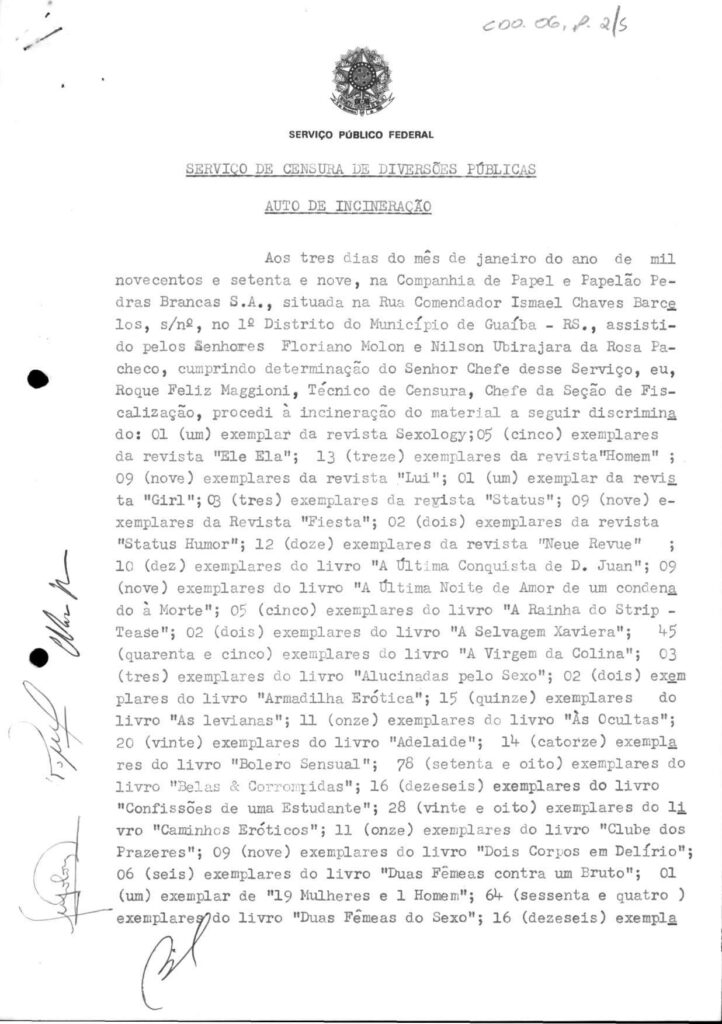
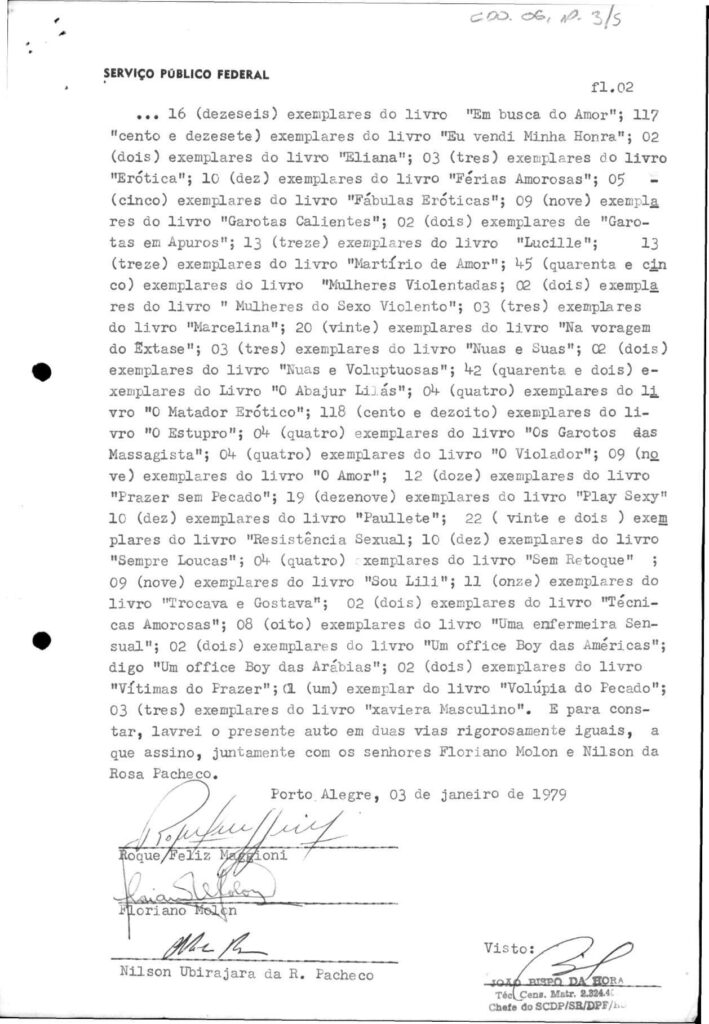
Morality was a prominent argument for censorship in Brazil, as documented in the holdings of the Brazilian National Archives. The files are titled “Auto de incineracão”, or incineration report. An official from the “Serviço de Censura de Diversões Públicas” meticulously lists the books and magazines he burned with the help of colleagues on January 3, June 19 and July 6, 1979, including the number of copies: These were almost exclusively works dealing with sexuality, eroticism and love.
This moral censorship was openly propagated by the regime. In contrast, political censorship is much more difficult to prove. In many cases, it was not realized through official indexing but, for example, by harassing authors or publishers. As a result, this form of censorship has often left no trace in the archives. There is a good reason for that: the military wanted to give themselves a democratic appearance. This reminds us of today’s dictatorships – a commitment to democracy is part of their representation to the outside world.
A systematic reappraisal of the Brazilian military dictatorship is therefore still necessary, even though a “truth commission” (2011-2014) has begun to come to terms with the historical events. A legal reappraisal is lacking. It is blocked not least by an amnesty law from August 28, 1979.
Although this amnesty law also lifted the censorship of previously banned media, it mainly pardoned the perpetrators themselves. In this way, according to the Inter-American Court of Human Rights, it hindered the prosecution of serious human rights violations.
However, the amnesty law did have one unintended subversive side effect: it led to the famous report “Brasil: Nunca Mais” (“Brazil: Never again”, 1985). This report gathers records about the crimes committed by the military, which had been compiled since 1979 in preparation for the amnesty procedures and secretly copied.
The atrocities committed by the Brazilian military regime remain an open wound in Brazilian history. Many of the regime’s victims, the so-called “disappeared”, remain missing.
Nevertheless, researchers are investigating the missing books in archives. We would like to thank Henrique Bordini (FAU Erlangen-Nuremberg) for sharing some of the results of his research with us. He has compiled some of his findings in the Arquivo Nacional (Brasil), Fundo/Coleção NS – Divisão de Censura de Diversões Públicas (DCDP), supported by Sandra Reimão, University of São Paulo, and by staff members of the Arquivo Nacional.
As of now, we have been able to add over 430 titles to the Kasseler Liste that were banned during the military dictatorship in Brazil.
Die Kasseler Liste, July 2025